Showing posts with label Kopan Monastery. Show all posts

Saturday, 9 August 2014

ANI WANGMO


Ani Wangmo's story is similar to Tanya's  (see Conversation with Tatjana Popovic), except that Tanya had decided that after the three-year retreat she preferred not to return to monastic life, for the time-being at least.  Ani Wangmo, on the other hand, took the robes and for the past 8-years she has been a nun.  Every story about becoming a monk or a nun is different, and Ani Wangmo's is no less engaging for being a personal account of the events in her life that brought her to a resolution to dedicate her life to the dharma.
Ani recalls her early experiences of becoming aware of eastern culture:  I was going to university for some time and then, after I went to India for the first time, I never went back to university.  When I heard that the Tibetans were actually in India, I decided I wanted to learn about Tibetan Buddhism.  I knew they were in Tibet, but Tibet was a difficult place to reach from Slovenia.  I didn't know anyone who had been to Tibet but I knew quite a few people who had been to India as tourists...I decided to go to India to see for myself

Having met some Tibetan monks in Ljubljana and asking where they came from, they told her they had a monastery near Dharamshala.  According to them, getting there was no problem.  Meditation in Slovenia was out of the question as there were no facilities for this, only new age things which appeared to Ani as being superficial.  She was looking for something with more substance, something more essential and serious to do with meditation.
Deciding to go to India, Ani took her mother with her and auspiciously met His Holiness Karmapa on the second day in Dharamshala.  The connection was quite clear.  It was in 2000, just a few months after his escape escape.  He was 15-years old.
Before she met him, she had seen a picture of him in Vienna.  It's kind of difficult to explain what happened when I saw the picture, but I knew that I had to meet him.  I didn't speak to His Holiness the first time because it was just a public audience; but soon after, we had a private audience also and then we talked to him a little bit through a translator.  Ani's mother was also impressed when meeting His Holiness Karmapa for the first time.
After two-months, Ani's mother returned home.  For another three-months, she remained in India and Nepal.  After a stay at Kopan Monastery,  Ani also visited   Pullahari Monastery.  On her next trip to India, she went to Sherab Ling, where she met her main teacher, Tai Situ Rinpoche, from whom she also took ordination just before starting a three-year retreat under the guidance of Ringu Tulku Rinpoche in Sikkim in 2006.
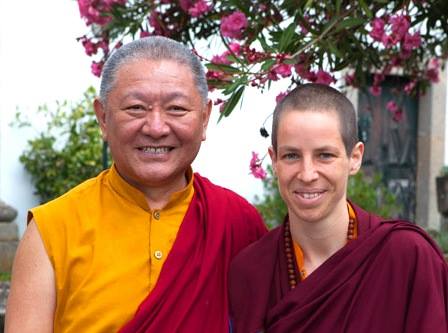


ani and rtr
Anila with Ringu Tulku Rinpoche
She says of her commitment to become a nun, I really wanted to become a nun, from the very first time I heard about this possibility.  I knew this was something I wanted to do but  also didn't want to do it right away because I saw so many people who have done it:  then after a few months I thought, "No!  This is not for me".  I didn't want that to happen for me.  Only when I was kind of sure, I let the wish be for a few years to see if it stayed, because the best way to check if you really want to do something, is not to do it but just to see if the wish stays in your mind.  And sometimes, it's not good just to jump into something and then you might regret it.  I didn't think I would regret it, but, you know what I'm trying to say.  Sometimes it's better just to let things be and see how it goes.
Ani has no regrets at all.  She took the life vows to remain a nun after the retreat .
Karma is often a difficult concept for westerners, but Ani has a simple explanation of what it is.  Having a past life is explained in the dharma:  If you want to know your past, you just look at yourself now.  So I think it's quite clear that there is some connection.  And if you want to know the future, just look at what you are doing now.
The conversation turned to freedom and Ani's views were also straightforward.  I don't think freedom has to do with whatever you want to do.  We think freedom is being able to do what we want, but does it really make us free?  Does it make us feel happy?  I don't think so.  Because when we talk, like in Buddhism, we have the discipline and the ethics and some people think that there are restrictions on their life.  But actually, they give you the freedom to do whatever is good for you.  So it's more free once you follow these things:  you're more free than just listening to your own, selfish kind of thoughts. Freedom is more like being able to do what is good for you, not being able to do whatever you want to do which will bring you more problems after.
I know people who say, "I want to be free , and they leave their family and everything and they go to some exotic island and they start to live there on the beach.  They can do whatever they want all year long.  But if you meet those people, they are not any more free or any more happy than us.
We get to talking about the differences between theory expounded in the Buddhist texts and the experiential aspects of life and how to live it according to the prescribed methods of practice.  Both the text and experience are necessary for transmission.  If somebody doesn't have the experience, nobody would understand the text.  Ringu Tulku Rinpoche said His Holiness Karmapa was talking more from his own experience than about traditional teaching [on his recent visit to Europe].   When Rinpoche is talking about our practice, you know that he's talking from his heart.  He's not saying how things should be, how things could be, he's just telling us the way to do it and you know that he does it too.  That's what makes you able to access the teachings: and it reaches your heart, otherwise there is no connection.
Recently, on BBC Radio 4, there was a discussion about happiness, what it is and how it can be achieved.  They really did get into a muddle.  Ani's ideas on happiness reflect her own experience and feelings about this subject.  We all really want happiness. We look for happiness.  All we are doing is doing things to get our happiness.  But obviously, we don't know the causes for happiness because we want happiness so badly that we're creating the causes for suffering, for problems, for unhappiness.  We don't see this connection - not knowing what the real causes of happiness are.  
Whatever happens in Ani la's life, she has certainly found out what she wants as well as the courage to live it to the full.

IMG_0298
Anila with Lama Shenga


Tuesday, 2 July 2013

HOLY ISLAND


HOLY ISLAND: THREE PERSPECTIVES

You can’t come to Holy Island and not be impressed!

For the naturalist, there is an abundance of wild plants including bluebells, primroses, wild strawberry, wild thyme, bog myrtle, the curiously-named quaking grass and pale butterwort, an insectivorous 
perennial that gets its nourishment from various flying bugs.

As well as the plants, there is also a surprising variety of wild life.  Apart from a unique stock of Hebridean Eriskay ponies, there are bronze age Soay sheep and Saanen goats (confusingly for me, city born and raised, the goats are white and the sheep are brown). The goats may have been left on the island some seven-hundred years ago by the Vikings, I read somewhere.

There is a large variety of birds including, the shy eider ducks, noisy oyster catchers and the hostile seagulls, the latter mainly nesting on the southern end of the island on a steep rock face. At this time of year, June/July, the unwary visitor might be attacked by a seagull protecting its young nesting on the rocky western shore of the Firth of Clyde.

The Community of Arran Seabed Trust has negotiated with the Scottish Parliament to assign Lamlash Bay a Marine Protected Area “No Take Zone” which probably encourages common grey seals, basking sharks, porpoises, dolphins and the occasional minke whale to hunt their prey there; although I've only seen one seal and one shark on my various visits to the island.

Now, in the second half of June, the accommodation is filled with people here for Ringu Tulku Rinpoche’s teaching on Karma Chagme’s A Quintessential Practice Unifying Mahamudra and Mahasiddhi:  and you can’t help but be impressed with the full turnout for the teaching.

John Gallagher stands out from the crowd.  Hailing from Glasgow, John is well over six-feet tall with a mop of jet black hair. 


John says he became interested in Buddhism only three-months before coming to the teaching.  Although he was aware of the dharma he says, I kind of always knew about Buddhism but I just didn't do anything about it.  I wasn't really looking for it.  I knew it existed, I knew there were places in Glasgow.  I felt a bit, not apprehensive, but a bit wary about it.  Not in a bad way.  I thought I didn't really need it at all.

Because of some recent incidents that happened in his life, John began to look to Buddhism to try to make sense of what was happening to him.  He became interested in the practices and decided that they would offer some kind of support by allowing him to develop a mindful approach to his problems.

He says of his first introduction to Buddhism, My first experience…was through my college. I was going through a bit of stress through work and dealing with certain things that came up, with college and with people as well. I needed to get more focus back because I thought I was going astray…I needed something to focus my mind on.  I knew that Buddhism was actually a good thing for training your mind. 

John also sensed that the sangha would offer him a social aspect to Buddhism as well.

John first found out about Ringu Tulku Rinpoche through a friend.  Coincidentally, someone in his college told him about the Holy Isle Project and that Rinpoche would be giving a teaching there.  He made some enquiries and after meeting Ani Sherab in Glasgow who told him about how she came to be a nun, he decided he would attend some classes.

About the teaching at Holy Isle, John explains, I think I picked the teaching up pretty well.  I don’t remember all of it, but when Ringu Tulku Rinpoche is teaching I find it goes in very easily. 

He also commented on the questions asked at the teaching:  I find that when people ask complicated questions at the end of a session, they seem to be overly complicated.  The answers sometimes seem to be a lot better than the questions.  He sometimes takes a while to think about the question…then gives a simple answer.  The answer is a lot clearer [than the question]. 


Anita Selva is from Seven Oaks in Kent.  She is a tad reluctant to categorise herself as a Buddhist:   I'm from Seven Oaks in Kent.  I have taken refuge but still don’t like to use the term, "I am a Buddhist".  I wouldn't generally say that, but I guess I am, without the labels.  I took refuge at Kopan Monastery, in Nepal a couple of years ago from a Lama who came from India and I just finished a one-month retreat there.  I was thinking of taking refuge again yesterday but I didn't so…

The retreat was a lamrin retreat, sort of mixed teachings, half and half silence and meditation.  Quite intense, that one.

Anita considers that her experience of Buddhism before the retreat was intellectual and theoretical, so the practical experience of the retreat itself was "quite intense".

Of her family life, Anita's family had  more of a secular approach to their religion:   My parents are Hindus but they’re not very religious, only when there’s a death or something.  You don’t notice anything religious going on.  I don’t really put up with much religion.

In her self-appraisal of where she had come to in her experience of Buddhism, Anita was discovering different types of Buddhism:  After Nepal I carried on travelling.  I went to visit family, Malaysia, Australia, a few different places, Thailand.  I forgot the practices I had learned in meditation.  I found differences in the types of Buddhism I saw in my travels. I've seen Thailand.  It’s very different, the way they carried out the rituals and everything and I found I'm still a complete beginner so it’s very new to me.  I'm still learning. A lot of it was very different.

Anita first heard of Ringu Tulku Rinpoche about four-years ago when she attended one of his talks in London.  She heard about this through her partner and "just went along".  Much of what she gleaned from the talk she felt was slightly interesting but it didn't make a big impression on her.  Gradually, Anita came to understand more about the practice.  She wasn't sure if she had made the right decision to come to Holy Island, but she was happy to be here:   I'm glad I came, she says.

Anita found the course relaxing compared to the retreat she had done at Kopan Monastery.  She felt, very chilled out, people are really friendly, welcoming.  I really liked it.  It’s not too separate.  It’s integrated.  Learning how to integrate, I think that’s important as well because I'm used to it being very disciplined, the last retreat, being told off…you must be in silence, that kind of thing.  The course here is very relaxed compared to the other meditation retreat I've done.

Again, Anita reiterates her dislike of having to declare a particular practice:    I like to pick and choose and not have to box myself into any thing.  That was my real aversion to it to start with, the whole religion thing. So I don’t like to think about that side of it.  Just sit and listen to the teachings; that helps me in day to day life.

Of her diet, Anita is articulate:  I'm a vegetarian for ethical reasons, mainly.  But it’s also learning about the health reasons.  All the suffering of all the animals.  On my own, I couldn't bear the thought of cutting up raw meat.  I just stopped having it.  I've been a vegetarian now for about six or seven-years. My mum was brought up as a vegetarian but she started eating meat when she met my dad.

That the state of one's mind can be communicated to animals, Anita is certain:  I teach horse-riding so I try to keep up the mindfulness when I'm teaching as well.  I meditate, not as often as I should, but it’s more mindfulness to me, just being aware.  I don’t set a time every day when I sit and meditate, but I come on this retreat, go home and try and do it again.  When I go to a horse show, I sit and still everything, just for a minute.  But I'm not into any particular practice at the moment, but I do shinay.

I think that general stillness can be transferred to animals, that peaceful calmness in you.  My horse definitely knows when I'm a bit agitated, if I'm riding in a more ego-centred way.  If you let things just flow, you’re listening more to them and you’re just kind of calm and still.  So I think it does definitely help a lot.  I'm quite interested in that aspect of meditation.  Dressage is what I do, so you have to quieten the mind.


Julian with his son, Max

Julian Stollmeyer was born and raised in Trinidad.  He lived in the United States for thirty-four years but went back to live in Trinidad to stay only one-year ago.

The primary reason I went to America was my interest in Buddhism and after seeing Chogyam Trungpa Rinpoche I went back to Trinidad for a year or two; but I didn't find any dharma or Buddhist sangha in Trinidad and I felt this very strong yearning to connect with the teaching.

Julian's experience of Buddhism was established some years ago:  Chogyam Trungpa Rinpoche is my primary teacher, my root guru, but he brought over numerous teachers also - the Karmapa, Tai Situ Rinpoche and Thrangu Rinpoche - over many years.
 

 Before he came to Holy Island, Julian's knowledge of Ringu Tulku Rinpoche was from a previous visit by his friend to Montserrat in the Carribean:  A friend of mine from Trinidad met Lama Rinchen in Montserrat some ten-years ago and invited him to teach in Trinidad.  Lama Rinchen now has a sangha in Trinidad and Tobago that is now a part of Bodhicharya Caribbean.


Julian's first meeting with Ringu Tulku Rinpoche was some time ago:  I first met RTR about 20 or 30-years ago in the nineties when he came to Colorado and taught at Naropa Institute.  I didn't hear much about him again until a couple of years ago when I was in Colorado.  His presentation of the dharma hasn't changed that much, though I don’t have a very precise memory of what he taught back then.  I remember the same, down-to-earth, accessible quality about the way he teaches.

Julian says he has enjoyed his stay on the island.  The teaching, as well as the food, he found to be memorable:  Holy Isle is unique.  I've never seen anything like it; an island in Europe that’s a Buddhist island.  The kind of sacred quality that it has, obviously being a practice-oriented place, maintaining the natural state.  Very little has been done to change [the environment].  You can really see the love and kindness that’s gone into cooking too.

Of the teaching, Julian has this to say:  The commentary on the text was clear.  Rinpoche explains things very well.

The course ends and the participants depart to return to their homes.  That Holy Island is a unique environment for the teaching of the dharma is unquestionable.  As Julian says, the Island has a "kind of sacred quality".  And it is the memory of the Island and the teaching that the visitors will take with them.  


RANDON THOUGHTS

When our son, Om, was 16 we sent him to NY to stay with his aunt in Queens. He spent 2 months hanging out and playing a guitar. I was info...